
Experience | Capacity | Expertise
Emerging AI & Quantum Solutions

PQCtoolkit
SOFtact Solutions
You're not quantum secure
until your vendors are.
Your migration runs through products you didn't build, on schedules you don't set. PQCtoolkit gives you control over who is going to update, and who is going to get replaced.
It reads the key exchange off the wire, the configuration off the host, and the CBOM out of your pipeline — then puts a documented verdict next to every claim.
Current Vendor PQC Status
Q3 review

This is what PQCtoolkit is for. Not a dashboard nobody outside your team will open — a list you can carry into a program review, a renewal negotiation, or a budget conversation. Colors are the product's own: blue for pure post-quantum, green for hybrid, yellow for capable but not configured, red for classical and still vulnerable.
OMB M-26-15
31 Dec 2030
0 days
OMB M-26-15
31 Dec 2031
0 days
HARVEST NOW,
DECRYPT LATER
TRAFFIC CAPTURED TODAY
NOW
The value chain
The cycle is the product
Discovery on its own is a snapshot, and a snapshot goes stale the day it is produced. The four four areas below are the four quadrants of the Executive Summary, and they are not four reports — each one consumes the area before it and sharpens what it hands to the next. That compounding is the whole argument, and it is why a scan you run once has almost none of the value of a scan you run on a rhythm.
01 Discover
HOST DISCOVERY - ENDPOINT SCAN
~PQC status for endpoints
~PQC status for applications
~FIPS status
~Recommended migration steps
Hands on: observed truth, grouped by
organization and by vendor —
exactly the shape the audit needs
02 Audit / Track
HUMAN AUDIT TOOL
~Vendor roadmaps
~System owner roadmaps
~Track future compliance dates
~Track deliverables and POA&M
Hands on: verified posture —
what is confirmed, what is disputed,
and who committed to what by when
04 Validate
NETWORK AND OS LOG ANALYSIS
~Checks endpoint compliance
~Catches rogue endpoints
~Highlights backsliding
~Validates audit claims
Hands on: evidence that settles the
claim — and the next cycle's input,
back to Discover
03 Model
PREDICTIVE MODELING TOOL
~PQC status for endpoints
~PQC status for applications
~FIPS status
~Recommended migration steps
Hands on: a phased plan with a finish
date per group, and the cost of
closing any gap
↻ Read clockwise — 04 hands back to 01

The Executive Summary carries the same four quadrants, each deep-linked to its detail — host scan, attested-versus-observed, wire posture, and the plan against the federal deadlines.
Run continuously, this is what crypto agility means
The classifier at the center is generated from one decision table. When the standards move — a new FIPS release, a deprecation, an agency policy change — the table is updated once, every deployment form regenerates in agreement, and the next cycle re-scores the entire enterprise against the new bar. Posture stops being a project and becomes an operating rhythm.
And when the classifier cannot determine whether a component is quantum-vulnerable, it says so: the finding is marked not-yet-classified and the specific gap is recorded rather than guessed at. You get an honest picture of your coverage and a well-posed work queue instead of false confidence.
Discover ------------------------------------ 01 / 04
Four sources of truth, one verdict
An inventory built from any single source is wrong in a predictable way: attestations are optimistic, host scans miss what only appears on the wire, and network capture cannot see what sits unused on disk. PQCtoolkit collects all four lenses and reconciles them against each other — so an over-claim becomes visible instead of becoming the record.
Attested — what they declare
A structured questionnaire captures declared algorithms, modules, modes and CMVP certificates, graded by assurance level so a certified claim outweighs a self-declared one.
Endpoint — what is installed
An agentless collector enumerates certificates, TLS cipher policy, SSH host keys, crypto libraries, entropy sources and per-application crypto engines from each host.
Network — what is negotiated
A passive sensor reads TLS, QUIC and SSH handshakes off a span port and records the key exchange that was genuinely agreed, never a configuration file's opinion of it.
Logs — what the systems reported
A reviewable pattern set scans application, service and OS logs for FIPS-mode state, deprecated primitives and post-quantum negotiation events.

Collection differs by lens; classification does not. One reviewed decision table produces every verdict, so the host scanner, the network sensor and the vendor questionnaire cannot quietly disagree about what “compliant” means.
You can't make a vendor quantum secure, but you can replace them.
PQCtoolkit puts the power in your hands
The mechanism
Getting vendors to quantum secure
The button you are looking for is acquisition management. Once you know how each supplier is actually implementing post-quantum cryptography — not what their datasheet says, what their product negotiates — you can write that knowledge into requirements for renewals and new acquisitions. For most applications this is a library upgrade and a few lines of code. Suppliers who control their own stack can do it. Many will not do it until a contract asks them to.
Two things are worth saying plainly. First, avoid one-off customizations: custom builds are expensive, thinly tested and poorly supported, and they leave you the only customer on that code path. Written into the acquisition lifecycle instead, the requirement gets priced by a competitive market, with full support. Second, you want your suppliers to succeed. There are far too many of them to replace, so the goal is a roadmap you can verify, not a procurement fight.
Where is it headed
Vendor and administrator roadmap dates are captured as commitments, not conversations — who has promised what, in which release, by when. Those dates feed the migration model directly, and later become the thing observed evidence is checked against.
Requirements you can defend
A finding backed by an observed handshake supports a contract requirement in a way a questionnaire response never will. Commitments that quietly slip become a documented procurement fact rather than an argument at renewal.
Winners and losers
Some suppliers are early and should win more of your business. Some are late and need replacing while there is still time to run the competition. Newer products have this baked in; older ones are retiring technical debt on your schedule or on their own.
One caveat PQCtoolkit will not let you skip: for most applications this really is a library upgrade, but for your PKI, your HSMs, your smartcards and anything with cryptography in silicon, it is not. Those are the findings to surface first, because they are the ones acquisition lead time cannot rescue late.
Drive ------------------------------------- 02 / 04
What to fix first, and who has to fix it
“Migrate everything” is not a plan, and it is not something you can hand to a supplier. Following the urgency ordering in NIST IR 8547, PQCtoolkit sorts every finding into one of four waves — because a broken cipher in use today and a signature algorithm that a future quantum computer might break are not the same emergency. Each finding carries a specific recommended remediation drawn from a reviewable policy map, and the same findings can be read by machine (who is affected) or by vulnerability (which single fix clears the most machines — and which single vendor owns it).
Sequencing matters more here than in most migrations, because systems that speak to each other have to move together. Twelve thousand applications are not twelve thousand independent tasks; they are a scheduling problem with lockstep constraints, and a wave that ignores those constraints produces an outage instead of a migration.
Wave 0 — Broken today
MD5, RC4, DES-class primitives: exploitable now, no quantum computer required.
Fix immediately
Wave 1 — Harvest now, decrypt later
Quantum-vulnerable key establishment protecting confidential data — TLS, VPN, Kerberos, disk encryption. Traffic captured today is decryptable later.
OMB M-26-15 encryption deadline — 31 December 2030
Wave 2 — Signatures and authentication
Certificates, SSH keys and code signing: secure until a cryptographically relevant quantum computer exists, then immediately forgeable.
OMB M-26-15 signature deadline — 31 December 2031
Wave 3 — Hybrid re-transition
Hybrid classical-plus-PQC constructions are protected now, but a second, smaller transition to pure post-quantum still remains.
Plan for it — do not be surprised by it
Each wave expands to the machines behind it, each machine to its individual findings, and each finding to the vendor who owns the fix.
Model ------------------------------------- 03 / 04
Everyone else hands you a snapshot. You need a roadmap.
A scan tells you where you stand this morning. It does not tell you whether this morning's staffing gets you to 31 December 2030. PQCtoolkit is deadline-aware: it projects a phased schedule from your own assumptions — system counts, engineers, effort per system, how much of the estate is crypto-agile, how much cannot migrate at all — and states plainly whether that plan meets each deadline or misses it, by how many days, and what would close the gap: this many more engineers, or this much less effort per system.
That verdict belongs in every report you send upward. When a deadline is not reachable with the resources you have, modeling it is the job — putting the cost and schedule tradeoff in front of management makes funding the migration a decision they make on the record, in 2027, rather than a shortfall anyone discovers in 2030. The planner speaks both languages: an engineering sequence for the people doing the work, and a cost, schedule and risk picture for the people approving it.
Real-world factors are modeled rather than assumed away: a genuine work year, ramp-up, attrition, procurement lead time, and the rework interoperability changes always generate. A built-in Mosca calculator answers the prior question — whether you can afford to wait at all.
The first projection is wrong; on day one it is nearly all assumptions. What makes it useful is what happens next — as scans land and commitments come due, assumptions are replaced with measured facts, so the forecast you carry into year three is mostly evidence.

Adjust any assumption — system counts, engineers, vendors — and the projection, the deadline verdicts and the cost estimate recompute immediately. “From scan” pre-fills the counts from real discovery data instead of estimates.

Every checked mandate is evaluated against this plan’s phase-ends and returns a plain verdict. A MISSES is not a failure — it is the number you take upstairs while there is still time to fund the difference.
Prove ------------------------------------- 03 / 04
Answers in days, or inside the platform you already run
How fast do you need the answer, and whose approval does it have to survive? Those are usually two different questions, so PQCtoolkit supports two deployment models. The standalone appliance gives you findings quickly with nothing to integrate, no other team's roadmap to join and no change board to clear. The native applications put crypto posture inside systems your organization already operates under an approval you already hold — the ServiceNow instance that holds your CMDB, the Splunk deployment that already receives your telemetry — so findings land where work is assigned and evidence already lives.
You can start standalone for a fast answer and move into the platform later: the classification engine and the data contract are identical either way, so nothing collected in the first approach is thrown away in the second. Every module is standalone too — install one, install all five, in any order. The seams between them are shared tables and open file formats, never hard dependencies, so a module you have not installed simply does not appear rather than breaking the ones you have.
ServiceNow
A scoped application with role-gated tables, Service Portal dashboards and optional Discovery integration, so host scanning rides your existing MID Server and enriches straight from the CMDB.
Splunk
A Splunk app with adoption, worklist, correlation and trending dashboards fed by the network sensor. Classification happens upstream, so the dashboards read a verdict rather than recompute one.
Elastic and OpenSearch
Pre-built dashboards for teams standardized on ELK or OpenSearch, drawing on the same collected evidence and the same vocabulary.
Standalone appliance
A self-contained container deployment for a fast first answer, and for air-gapped, classified or evaluation environments that need the full platform with no external dependency and no integration work.
Supply chain — CycloneDX CBOM
CycloneDX 1.6 cryptographic bills of materials import directly as evidence, whether produced by PQCtoolkit or by a third-party SBOM tool already in your pipeline — and export cleanly into your GRC record, so a supplier's own artifact becomes part of the file you hold on the product.
Evidence you can defend
Findings reconcile attested claims against observed reality, so a submission is backed by measurement rather than by assertion — yours or anyone else's.


ServiceNow. The same four lenses, running as a scoped native application inside the instance that already holds your CMDB — role-gated, under the platform’s authorization.
Splunk. Wire posture from the passive sensor, already classified upstream. The dashboards read a verdict rather than recompute one in SPL — including an honest indeterminate count for measurement blind spots.
REACH
Collectors that scale down as far as the estate goes
Coverage fails at the edges — the branch office with no room for a server, the isolated enclave, the single device nobody wants to touch. Those are also the places a supplier's claim goes unchecked longest. PQCtoolkit's collection tier is deliberately layered so the footprint shrinks as you move outward while the data contract stays identical: a central node carries the full platform; regional nodes aggregate; site collectors analyze traffic locally where there is capacity, or capture, filter and forward where there is not; and at the far edge a dependency-free script runs on the target itself.
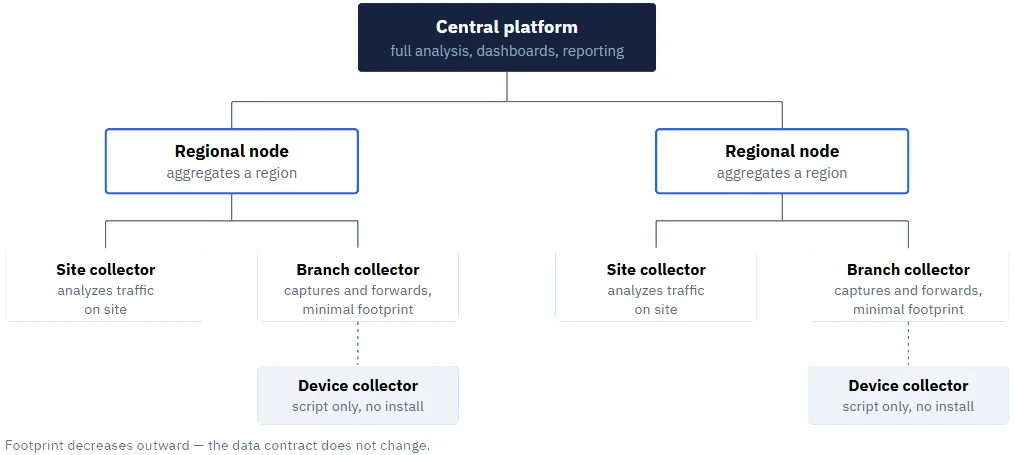
Every tier speaks the same payload format to the same classification engine. Sites with capacity analyze locally; sites without capture, filter and forward to a parent that can. A finding from a branch office is indistinguishable in quality from one collected at headquarters.
Quantum-ready today. Crypto-agile for whatever's next.
SOFtact Solutions — PQCtoolkit · in**@**************ns.com